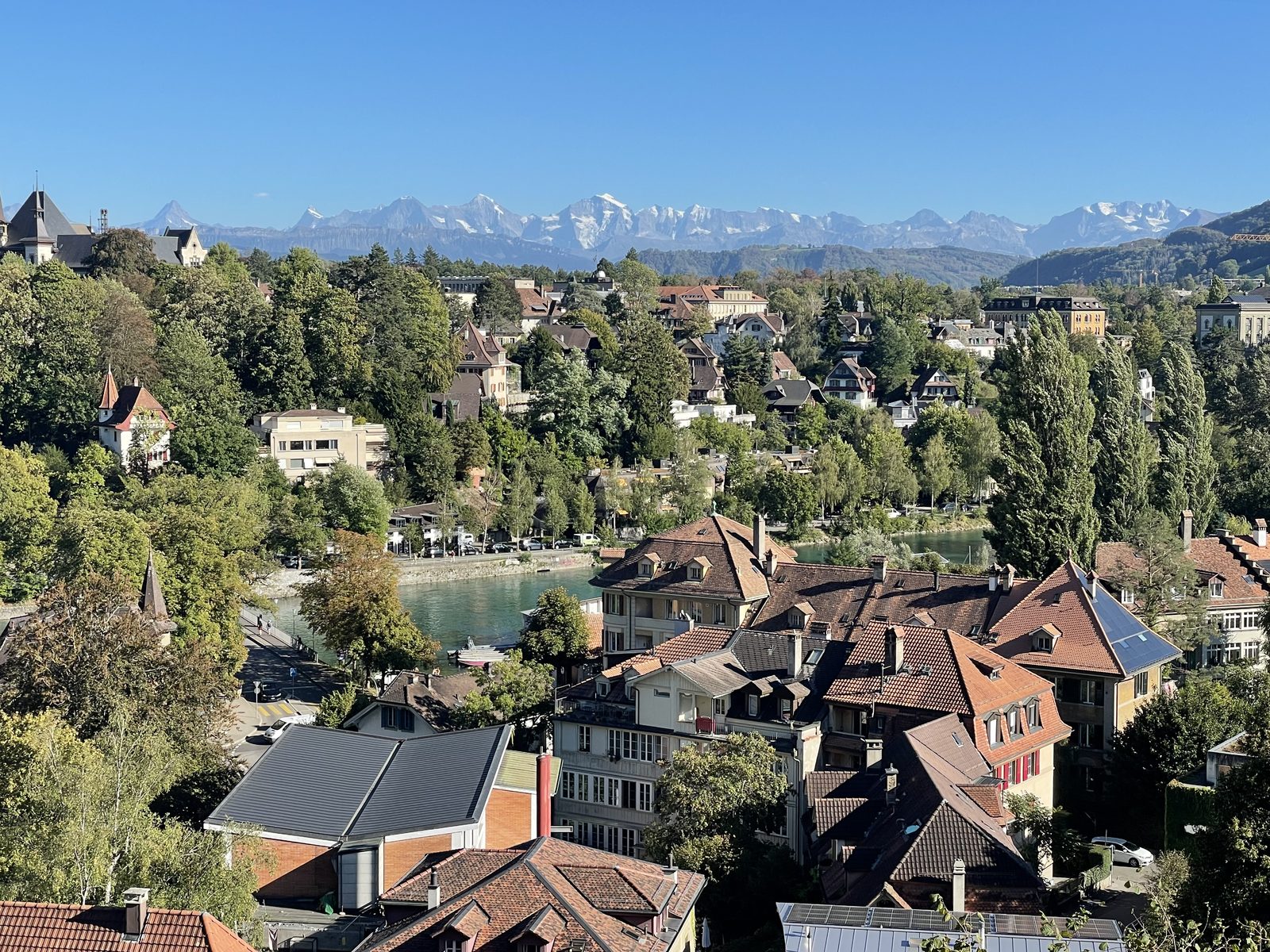
Bern, Switzerland's Federal City, is only an hour by train from Zurich. A guided visit of the Federal Palace taught me more than I care to admit, from a fish hidden in a mural to the women who waited until 1990 for an equal vote. Then came a long lunch, a stroll under the arcades, and a look at the sandstone cellars beneath them.
Inside the Federal Palace
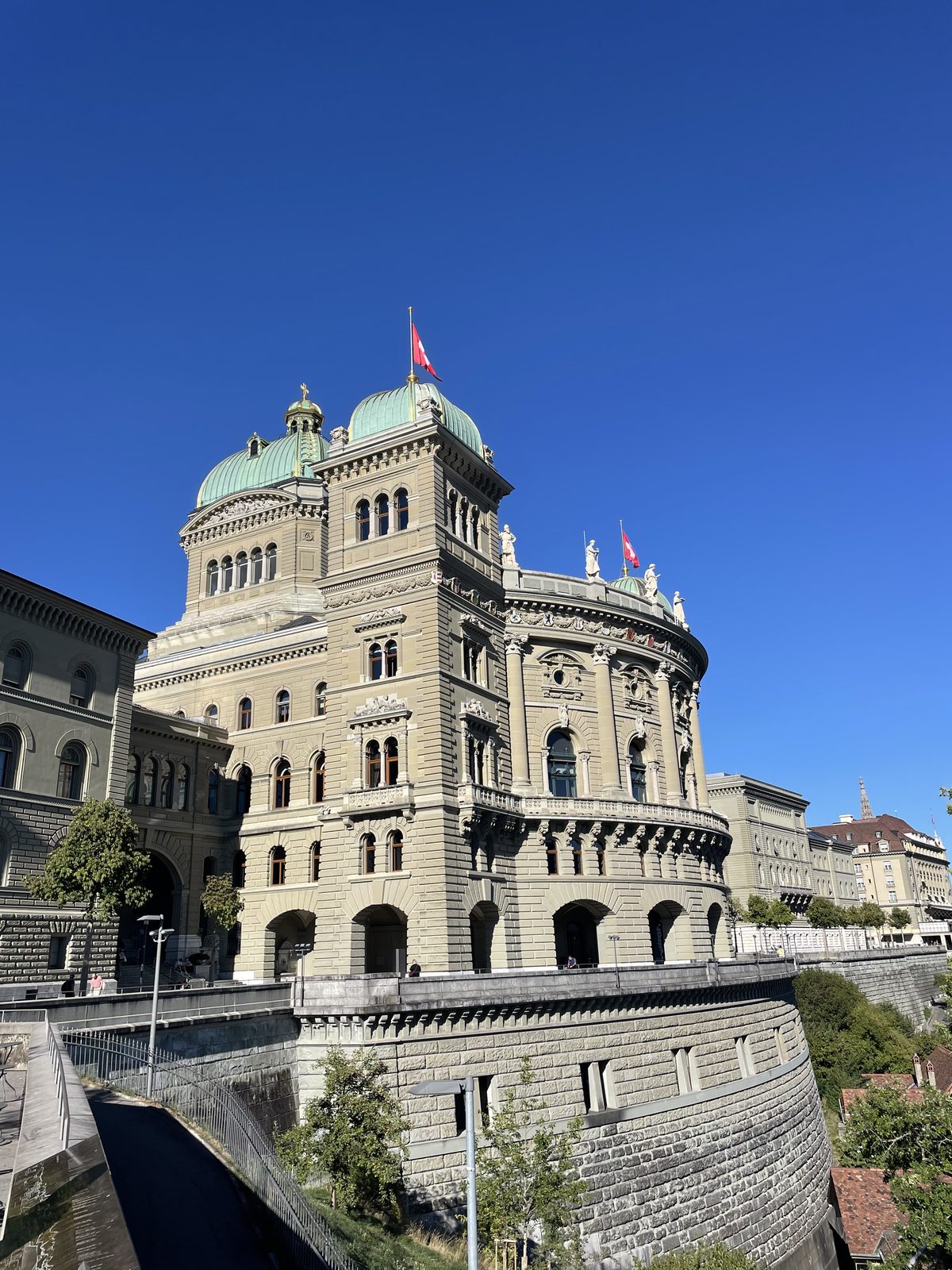
The following day, we traveled one hour by train to Bern, Switzerland's Federal City. We had scheduled an 11 a.m. guided visit. The "Federal Palace" was completed in 1902. The complex houses three buildings: the Parliament Building in the center, flanked by the east and west wings of the Federal Palace. My personal highlights include the Dufour Map behind the reception desk. At a scale of 1:100,000, it is the first official map of the whole country (the one on display is a 2015 reprint made from the original copper plates). The Federal building was Swiss made and involved 175 companies and 33 artists, and 97% of the materials were sourced in Switzerland. Every detail is meant to convey Switzerland's cultural diversity, history, values, languages and industries. It is a marvel.
The Domed Hall and the loggia
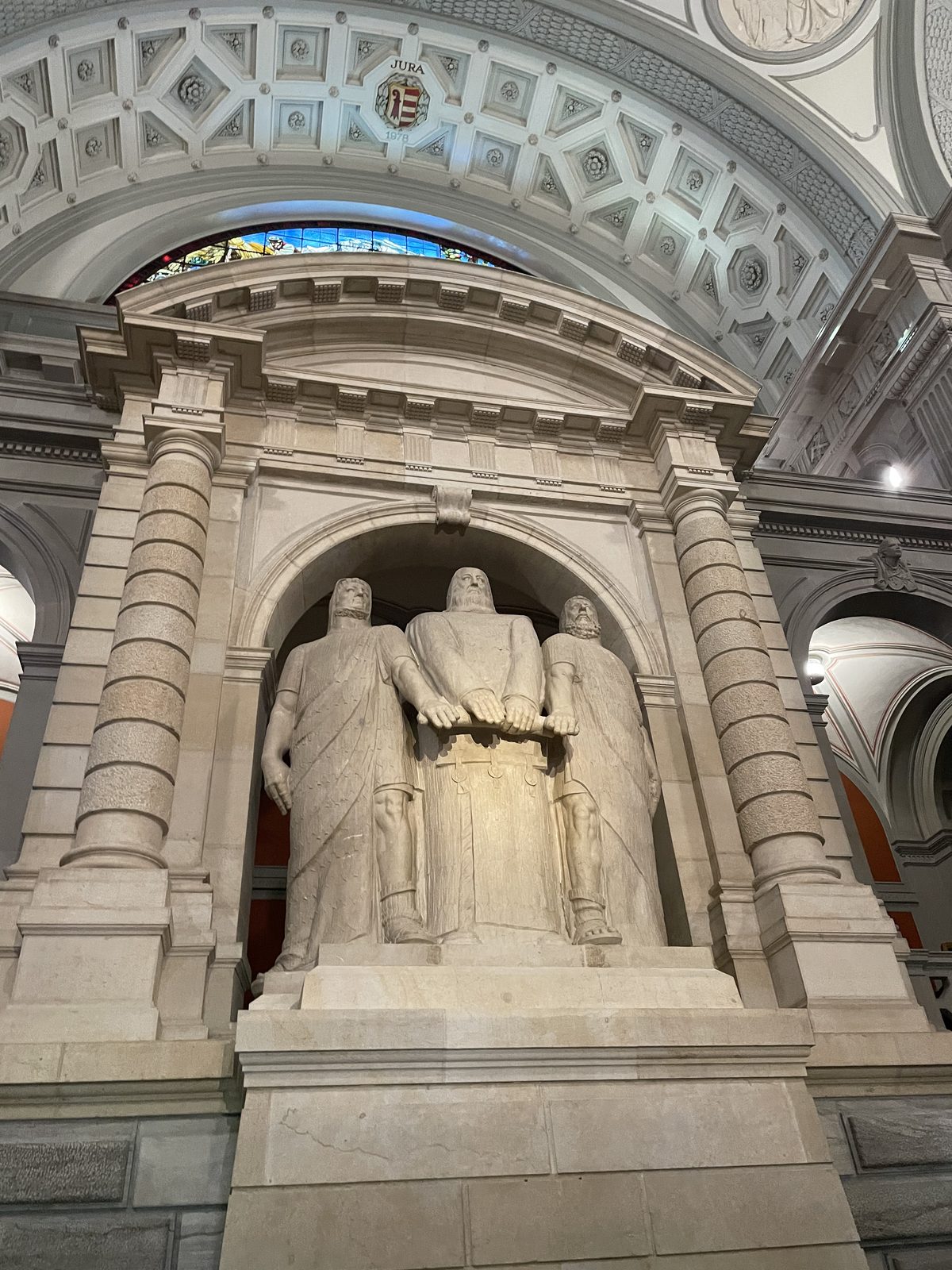
In the Domed Hall, the imposing 24-tonne monument to the legendary "Three Confederates" is an impressive historical reminder of the founding of the Confederation. But what intrigued me most was the explanation of why the architect had included a ceremonial balcony, a loggia. The guide reminded us of the geopolitical situation of Europe at the start of the 20th century. Switzerland in 1902 was unusual: a federal republic governed by elected representatives, with no head of state at all in the monarchical sense. Its system of direct democracy, with citizen referenda on legislation, was radical by any European standard of the time.
Switzerland, surrounded by emperors and kings, had been quietly running one of the most modern democratic systems on the continent since 1848, while its neighbors were still sorting out whether their monarchs would share power at all.
The ceremonial balcony symbolically shows the defining role of Swiss citizens as the sovereign power in a direct democracy. No politician is to step onto the loggia; instead, they pass underneath it to show that they are the servants of the people.
Four national languages
Something else I learned: our guide listed the national languages (French, German, Italian and Romansh) and explained that the official Romansh is a standardized version of the dialects spoken by 0.5% of the population, mainly in Graubünden. Romansh has five living dialects: Sursilvan, Sutsilvan, Surmiran, Puter and Vallader, each spoken in a different valley of Graubünden, each with its own spelling, vocabulary and feel. They are distinct enough that speakers of one don't always easily read another.
Rumantsch Grischun, the standardized written form introduced in 1982 by the linguist Heinrich Schmid, was constructed as a compromise across all five, averaging their forms rather than elevating any one of them. That's why it feels artificial to native speakers of any particular valley: nobody grew up speaking it. It's used for federal communications and signage, but many Romansh speakers prefer their own idiom for actual writing and feel little emotional attachment to the standard form.
The Council of States chandelier
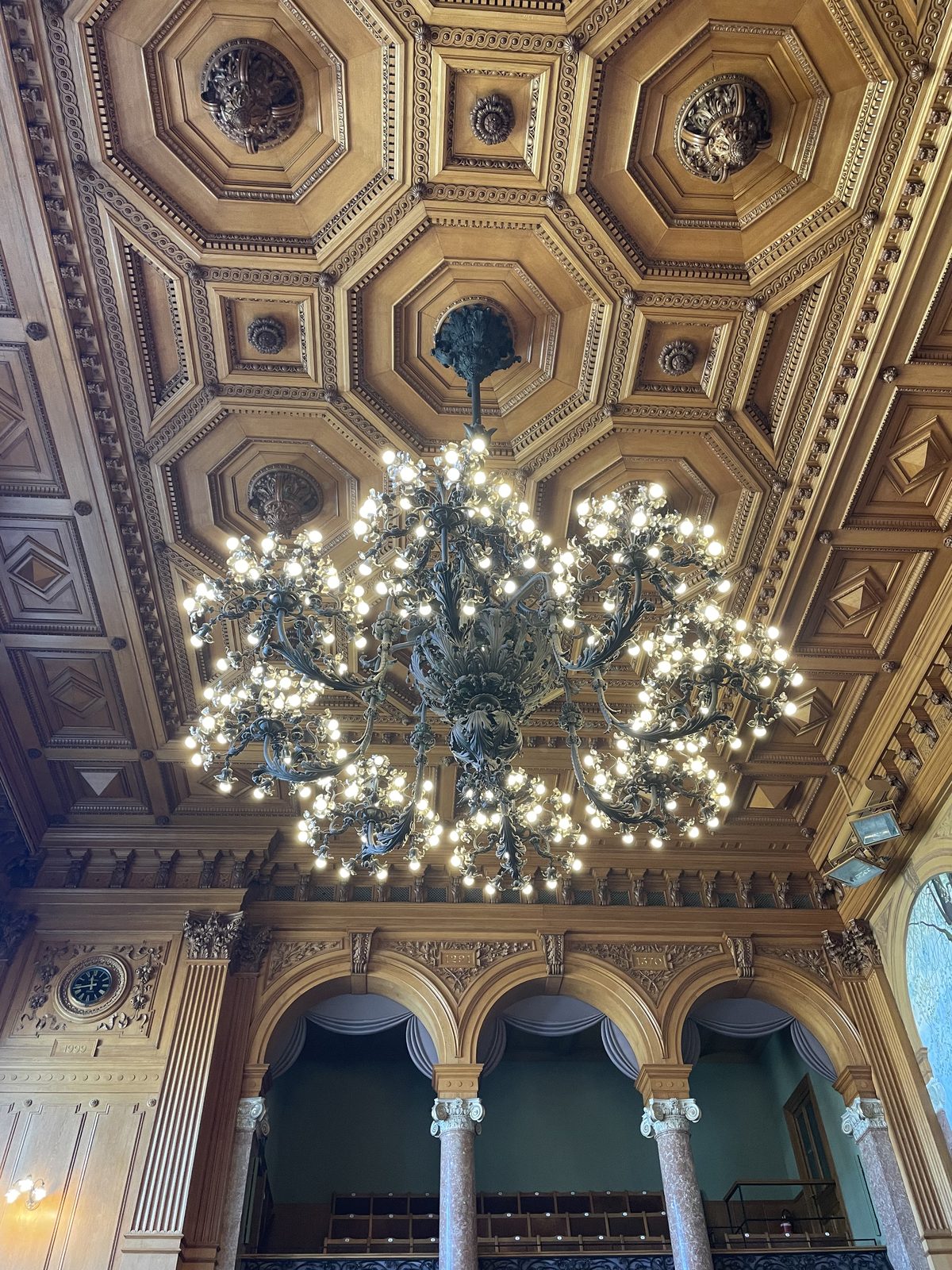
Back to the Federal Palace. The chandelier in the Council of States Chamber is stunning. It weighs 1.5 tons, has 208 bulbs and was one of the first electric chandeliers ever made. It is made of black wrought iron: scrolling acanthus leaves and branching arms spread outward in tiers, the ironwork curling like a forest canopy. Clustered at the end of each branch are small globe bulbs, 208 of them, glowing warmly, with no shades and no crystal, just bare light in the manner of the earliest electric fixtures.
The Cradle of the Confederation
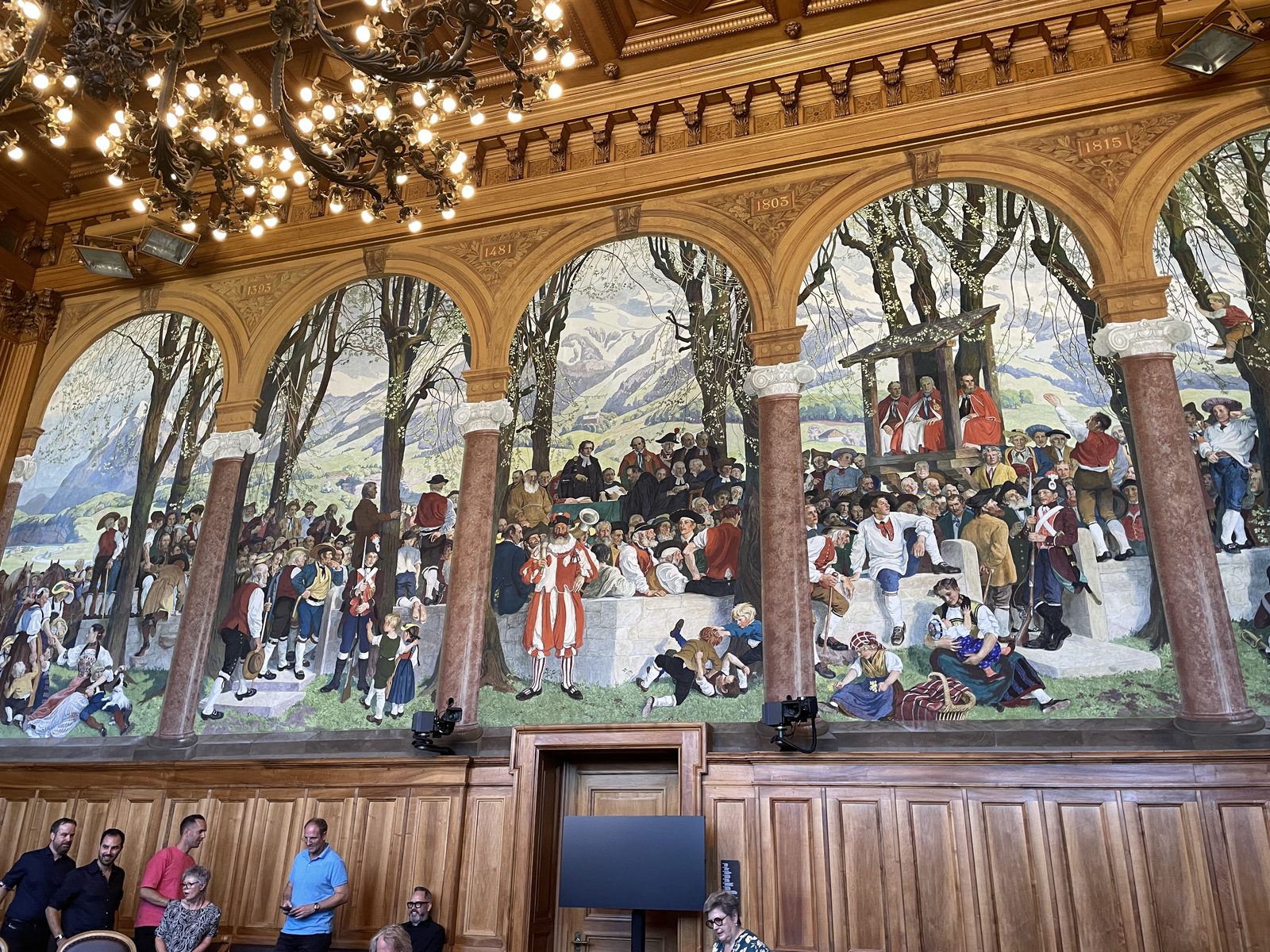
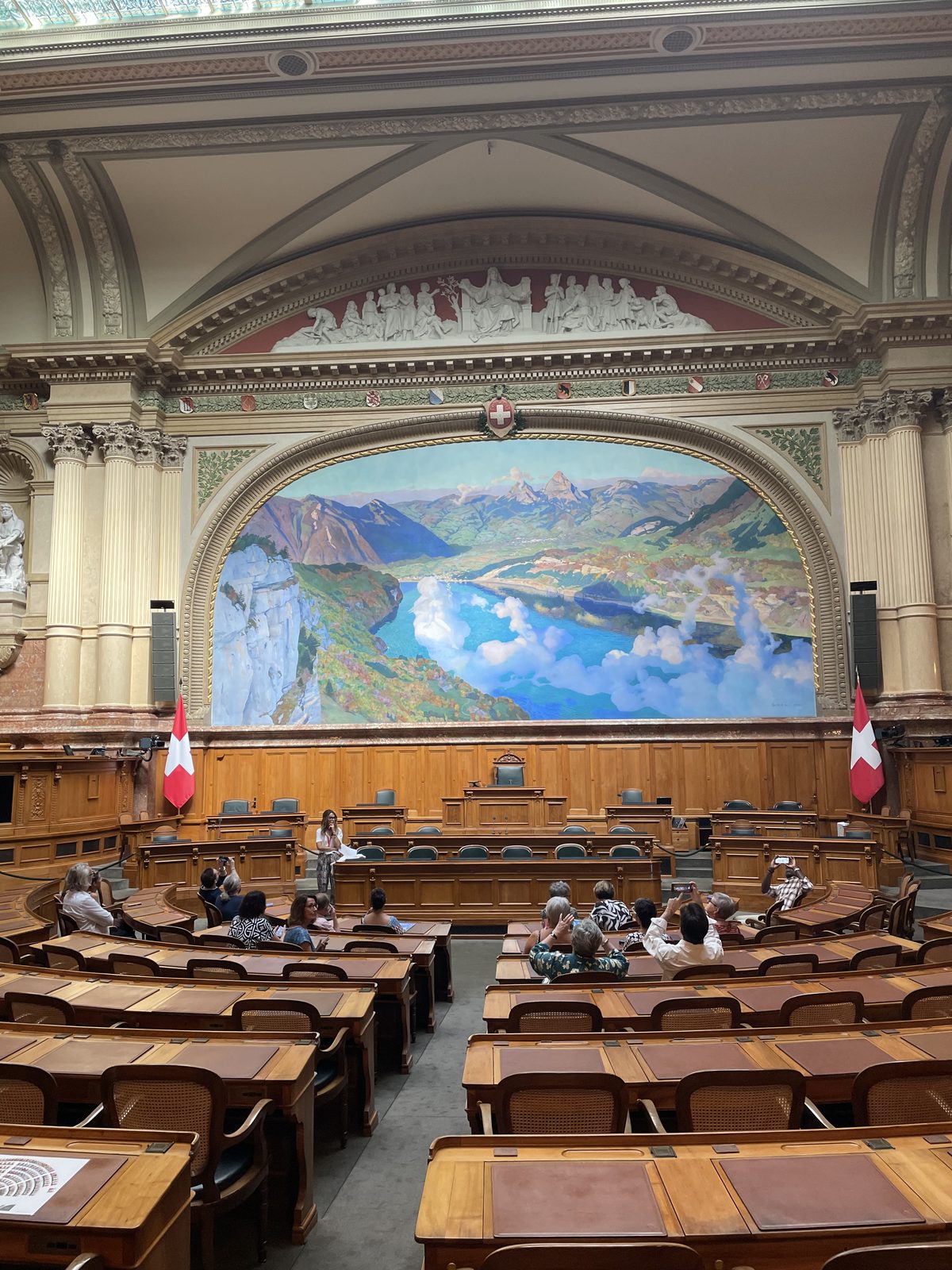
In the National Council Chamber, I admired the "Cradle of the Confederation" mural depicting Lake Lucerne and the Rütli meadow, where in 1291 three mountain farmers had the foresight to form an alliance. That alliance was the beginning of the old Swiss Confederation; the modern federal state followed in 1848. The painting was inaugurated on April 1, 1902, and the artist cleverly painted a fish on a grassy ledge as an April Fools' joke. It is well done, and I would not have noticed it if our guide hadn't pointed it out. Apparently, neither did the architect at the time.
Gertrud Stauffacher
The painting is flanked on both sides by statues. On the left stands the legendary hero William Tell, symbolizing political freedom and action. On the right, a statue of Gertrud Stauffacher, whom I had, embarrassingly, never heard of. She embodies the noble idea of the Swiss Confederation. A clever and wise woman, she suggested to her husband, Werner, that Uri, Schwyz and Unterwalden should form an alliance. The story goes that a Habsburg bailiff, seeing the Stauffacher family's prosperous stone house in Steinen (canton of Schwyz), questioned Werner threateningly about who had built it, implying the Habsburgs might claim it. She counseled him that the time had come to act, to seek allies in Uri and Unterwalden, and to resist Habsburg tyranny before it was too late.
The Salle des pas perdus
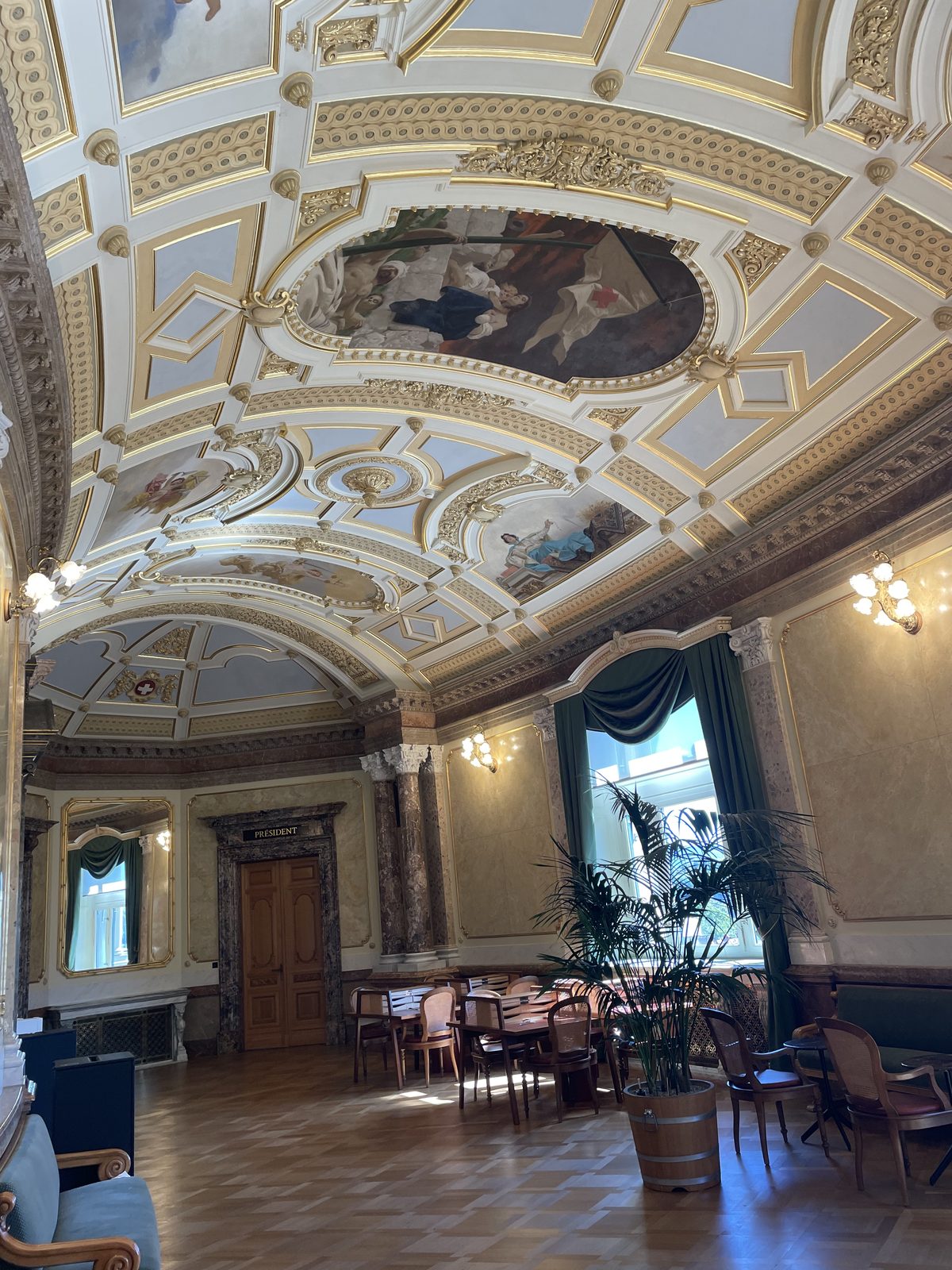
Our guided visit ended in the lobby, the Salle des pas perdus, a play on French words (pas meaning "steps," but also used for negation). This is the space where politicians, Council members, lobbyists and foreign dignitaries discuss, convince, promote their issues, welcome guests and hold official meetings, often walking through the curved Belle Époque lobby. Margaret Thatcher was the first female foreign head of government to be hosted there, in the 1980s.
Swiss women and the vote
Which brings me to my final observation, what I understand and take away from this visit: women's emancipation in Switzerland.
The constitution of 1848 formed a country that, unlike its neighbors, gave its citizens a direct voice and spread executive power across the seven members of a Federal Council, deliberately diluting authority at the top. It was a remarkable act of political foresight. Yet Switzerland, this pioneer of direct democracy, was among the very last countries in the Western world to extend the vote to all its female citizens. In 1971, long after France (1944), Italy (1945) and even Germany (1919), Swiss women finally gained the right to vote in federal elections. But cantonal resistance lingered. Several cantons withheld women's voting rights in local elections for years afterward, and Appenzell Innerrhoden held out until 1990, when the Federal Supreme Court in Lausanne ruled that the exclusion violated the federal constitution. Only then, in a country that had championed the citizen's voice for over a century, did every woman in Switzerland finally have an equal share of it.
I think that Gertrud Stauffacher, who set the Swiss liberation movement in motion, might not have appreciated the wait...
Visiting the Federal Palace
It was a fantastic visit. A few things to know: only guided visits are permitted, and booking is online only. Select the language, time and day. You must pass your bag through TSA-like security and leave dangerous items (like my picnic knife) and not-so-dangerous items (water) behind. Thankfully, I was able to retrieve my beloved knife after the visit. All bags are stored in free lockers. The visit was free.
Lunch at Lötschberg
It was another hot day in Switzerland. And I was hungry. I had to scout the December tour lunch location, so we headed to Lötschberg. The exterior of the building contrasts with the welcoming, traditional interior. We lingered over an almost two-hour lunch. We started with Alpine cheese and cured meat appetizers. My husband ordered spätzli, and I ordered a salade vaudoise with saucisson vaudois. I drank a glass of white wine from Auvernier (which we had visited while in Neuchâtel!). For dessert, I ordered meringues with double cream and whipped cream, accompanied by a sweet dessert wine from Valais and coffee. It goes without saying that we skipped dinner that night!
Across from the restaurant there was an enticing Swiss-made store: everything created and sourced in the country, quality and prices as well.
Under the arcades: the Lauben and the cellars
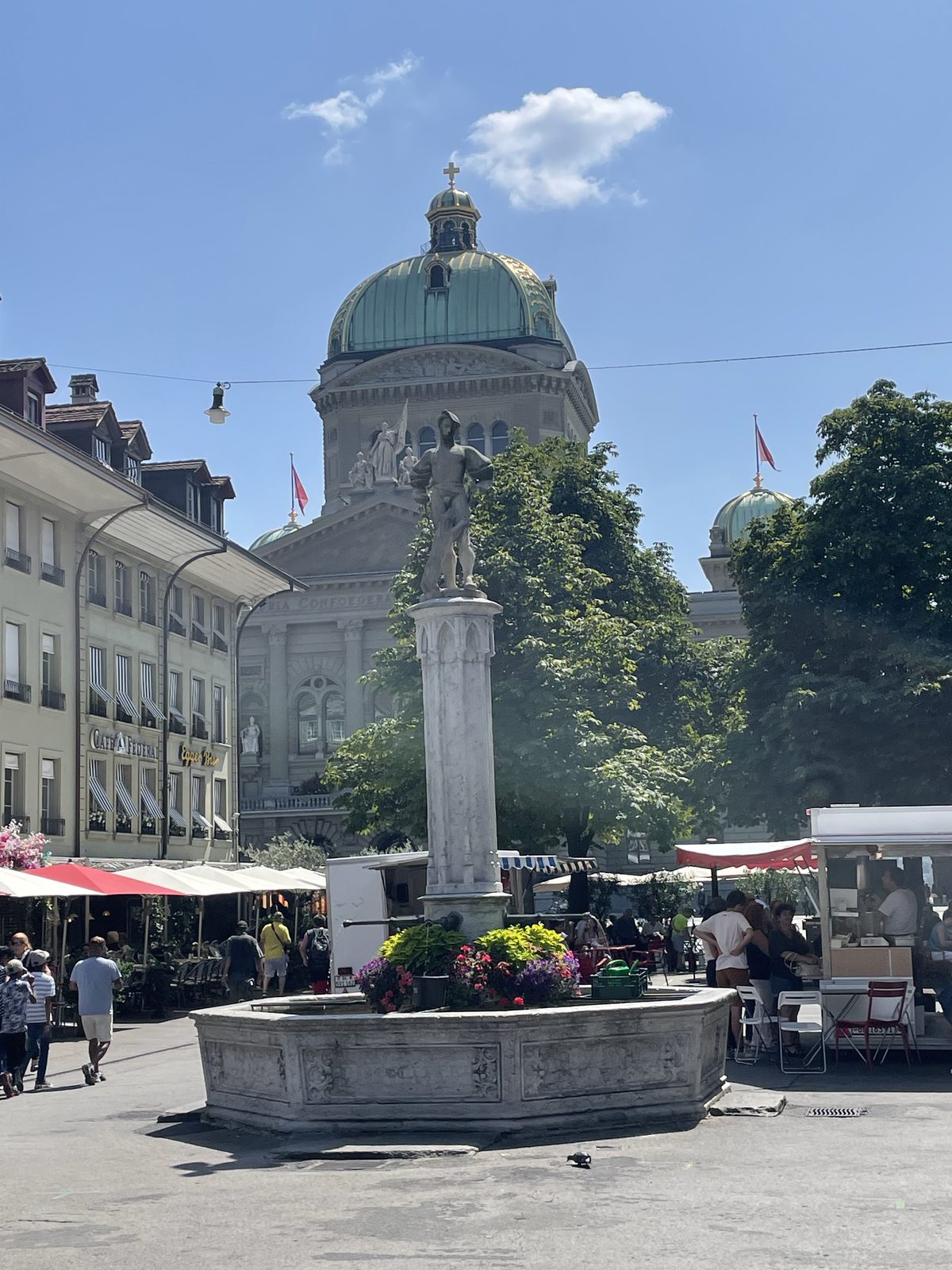
We strolled down the medieval street with its colorful fountains, medieval buildings and the iconic Lauben, Bern's famous arcaded walkways, and what lies beneath them.
Bern was founded in 1191 by Berthold V of Zähringen, and from the beginning it was planned with unusual deliberateness. The main streets were laid out wide and straight, with covered arcades running along both sides, the Lauben, so that merchants and citizens could walk, trade and move through the city in all weather, which in Bern is considerable. These arcades stretch for almost four miles (about 6 km) in total, making them one of the longest covered pedestrian networks in the world. To be precise, Bern is often cited as having the longest covered pedestrian arcade of a specific type: a continuous, architecturally unified, medieval street-level colonnade integrated into an urban grid. The emphasis is on arcade in the classical sense, a walkway with the building above supported by arches or columns, open to the street on one side.
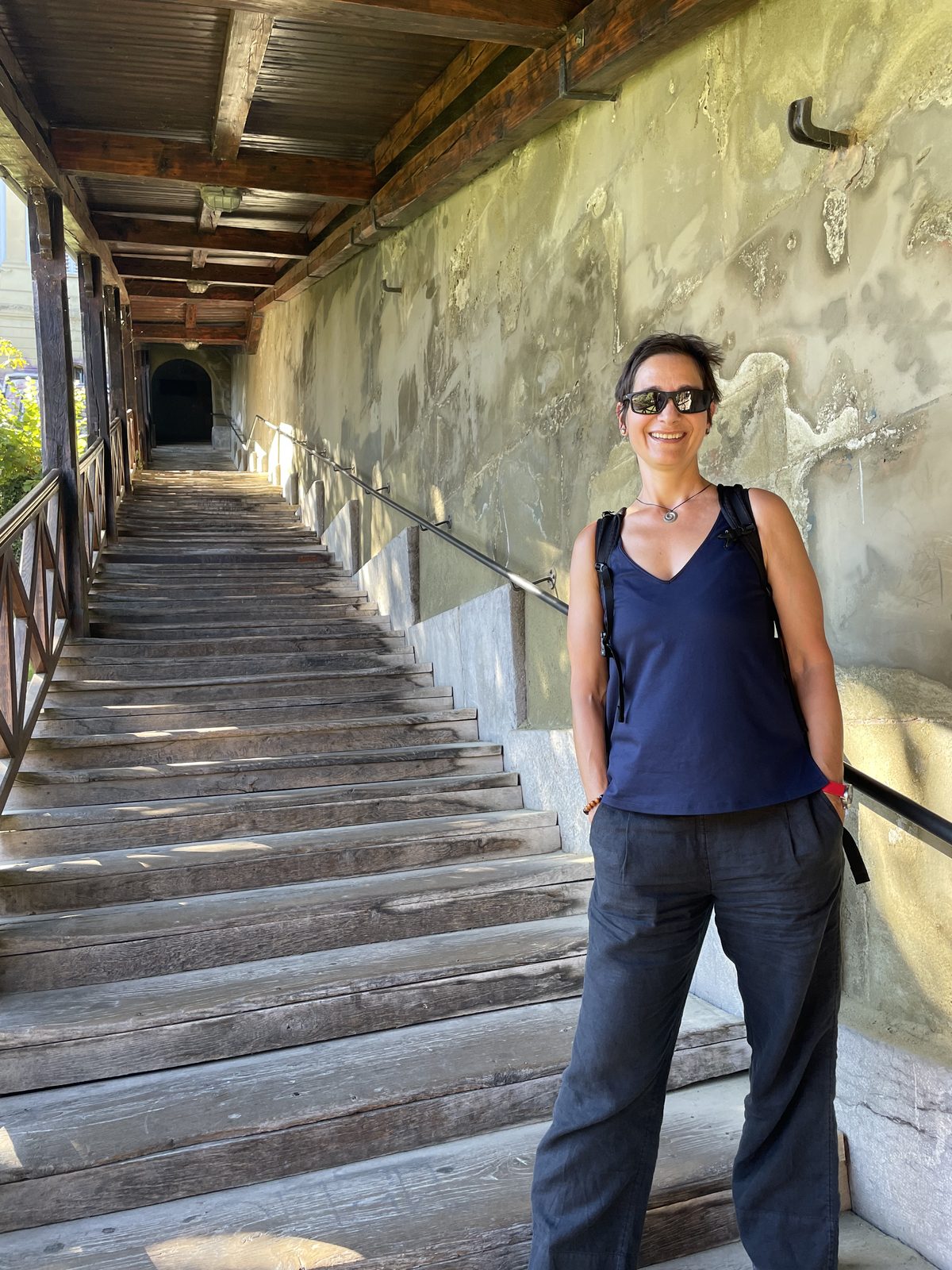
Beneath the arcades, and beneath the buildings behind them, runs a parallel world of Gothic cellars. They date largely from the 14th to 16th centuries, cut directly into the sandstone on which Bern sits, and they descend steeply from street level, often by an external staircase set into the arcade itself, tucked between the columns. You step down from the covered walkway directly into the vaulted space below.
These cellars originally served as storage: merchants kept goods there, wine and provisions. But over the centuries they became workshops, taverns and small businesses. Today many house restaurants, wine bars, galleries, second-hand shops and boutiques, their low sandstone vaults and thick walls giving them an atmosphere that no purpose-built space could replicate. The stone stays cool year-round, which made the cellars ideal for storage then and creates a particular mood now.
The warm golden-yellow of Bern's sandstone, the same material as the Federal Palace, runs through the entire city, arcades and cellars alike, giving Bern a visual coherence that is quite unlike anywhere else in Switzerland.
Good to know
Getting there
- Zurich to Bern: about one hour by train.
Visiting the Federal Palace
- Guided visits only, booked online. Choose your language, day and time.
- Security: bags go through airport-style screening. Knives and water must be left behind, and bags are stored in free lockers.
- Cost: the visit was free.
Bern's old town
- The Lauben: almost four miles (about 6 km) of covered arcades, so Bern is a good choice in any weather.
- The cellars: look for the steep stairs between the arcade columns. Many lead down to restaurants, wine bars, galleries and boutiques.
Details as of September 2026.